
Gerard Gaskin: Trinidad Artists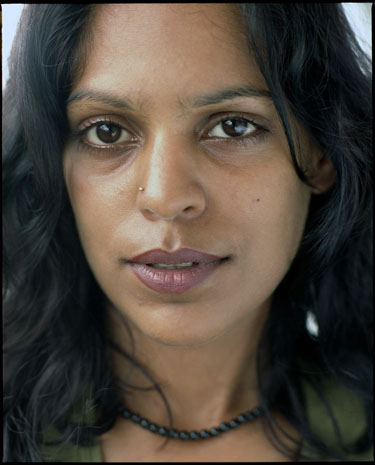
Artist Sabrina Charran; photographed October 2006
New York-based Trinidadian photographer Gerard Gaskin is working on an ongoing series called Trinidad Artists: portraits not just of visual artists but also of musicians and writers from his home island, all shot in deadpan close-up, at once formal and almost painfully intimate. A selection of images from the series is posted on Gaskin's website (click the "portfolio" link).
(Gaskin also participated in Galvanize 2006; see more information about his Galvanize project here.)
Saturday, 12 May 2007

Friday, 11 May 2007
More bedside books
After sharing a list of my current bedside books last Monday, I asked a couple of CRB contributors to do the same.
Marlon James (whose last appearance in the CRB was in a conversation with Mark McWatt and Annie Paul in our November 2006 issue) posted his list over at his blog, Croaking Marley. It starts with Zbigniew Herbert and ends with a 500-page "history of the west", and it makes me wish I could give up all other forms of occupation and take to my bed for a year, to do nothing but read.
And here, dear readers, is a list compiled by Jonathan Ali (who most recently reviewed books by Willi Chen and Pamela Mordecai in the February 2007 CRB). Jonathan opens with a little lament about the reading habits of his compatriots:
Books to the left of me, books to the right....
What your bedside reading says about you is relative. It’s relative to the attitude that the culture you live in has towards reading. In Trinidad, if your bedside reading comprises more than one book, and said book isn’t by Dan Brown or Terry McMillan or Deepak Chopra, or isn’t Harry Potter and the Something of Something, you are a freak. If you are the sort of person who doesn’t think having a stack of proper books by the side of the bed is a freakish thing to do (and if you’re reading this you must be), then make of the following what you will. Most of these books I’m re-reading, some I’m reading for the first time and some I haven’t read yet.
Books on my bedside table (to the left of my bed):
- In Spite of the Gods: The Strange Rise of Modern India, Edward Luce
- The Argumentative Indian: Writings on Indian History, Culture and Identity, Amartya Sen
- An Area of Darkness, V.S. Naipaul
- India: A Wounded Civilisation, V.S. Naipaul
- Guns, Germs, and Steel: A Short History of Everybody for the Past 13,000 Years, Jared Diamond
- Enterprise of the Indies, edited by George Lamming with an afterword by Lloyd Best.
I haven’t touched the last two books on this list in months. But they serve a valuable purpose where they are: they make it easier for me to reach over and pick up one of the other books, in particular the Diamond tome, which is quite fat.
Now, to the right of my bed is my desk. I draw books for reading in bed from the stack here as much as I do from the bedside table stack. On my desk at the moment:
- Malgudi Days, R.K. Narayan
- The Metamorphosis, In the Penal Colony and Other Stories, Franz Kafka
- Labyrinths: Selected Stories & Other Writings, Jorge Luis Borges
- Cloud Atlas, David Mitchell
- The Jaguar Smile: A Nicaraguan Journey, Salman Rushdie
- Shame, Salman Rushdie
- The Duppy, Anthony Winkler
- Almost Heaven, Niala Maharaj
- Iron Balloons: Hit Fiction from Jamaica’s Calabash Writer’s Workshop, various authors
- She’s Gone, Kwame Dawes
- New and Selected Poems, Kwame Dawes
- Arion and the Dolphin, Vikram Seth
- “The Women of Pedro Almodóvar”, an essay by Daniel Mendelsohn, from the March 1, 2007, issue of The New York Review of Books
- The Oxford Concise English Dictionary
- The Trinidad & Tobago Telephone Directory, 2005-2006 (I don’t read this in bed)
Not books (but of artistic interest):
- Heaven Up Here, Echo and the Bunnymen, and Black on Both Sides, Mos Def
- The Queen, directed by Stephen Frears, and Donnie Darko, directed by Richard Kelly
As I said, make of these lists what you will. Just in writing this I’ve realised that my bedside reading is all non-fiction, and the books on the desk almost all fiction. This is unintentional, of course. But is it significant?
-- JA
Caribbean lit links roundup
• Geoffrey Philp celebrates Kamau Brathwaite's birthday by posting a podcast of Brathwaite's poem "Francina" and a new poem by Opal Palmer Adisa:
reinscribing
love is not an ideal
but power to render
truth in the present....
Happy birthday, Kamau Brathwaite
• Nalo Hopkinson, recovered from a short illness, posts two entries from her "writing log": one, two.
• At the Poetry Foundation blog, Kwame Dawes posts two thoughtful essays: on political poetry, and on the importance of the imagination, the role of poetry, and what people expect from poets.
• In the Jamaica Observer, Michael A. Edwards talks to actor Roger Guenveur Smith, who will perform his one-man play Who Killed Bob Marley? at the Calabash Literary Festival at the end of May:
"For me, it's a cultural question, it's very personal. It has everything to do with how I identify myself with Jamaica, with music, as represented by Bob and the overall culture."
• In The Hindu, the Indian editor of the Poetry International Web, Arundhathi Subramaniam, reflects on questions of identity, displacement, and cultural authenticity, and is reassured by some lines from Derek Walcott's "The Schooner Flight".
• The premiere of Rough Crossings, a play by Caryl Phillips, adapted from a Simon Schama book, has been postponed--or cancelled?--due to the unexpected announcement that Bristol's Old Vic will close for refurbishment, reports the UK Guardian.
• And Shelf Space, the Bookforum blog, links to three pieces from the CRB archive.
Thursday, 10 May 2007
Talking to Kei Miller
"Kei Miller ... writes with passionate understanding of bruised, repressed, and deprived selves seeking, achieving, or failing to find release and freedom." So wrote Edward Baugh, reviewing the young Jamaican's debut books of short fiction and poems in the February 2007 CRB. Miller went on to be nominated for a regional Commonwealth Writers' Prize for The Fear of Stones. Two poems from his forthcoming second collection appeared in the May 2007 CRB. In this short interview, Miller discusses these new poems, "First and Second Book of Chronicles," as well as the role of Christianity in his work, and the evolution of his new book.
NL: The titles of these two poems ("First and Second Book of Chronicles") seem to be biblical references. Are they part of a longer sequence?
KM: They are part of a "sequence", though that's not exactly the right term. The relationship between the poems tends only to be in the titles. I found it a neat kind of structuring device. Each title became a way to contain a specific poem. I think poets are always looking for that--interesting containers, whether that is in the metre, the form, etc. These titles would suggest their own stories, and sometimes edit the kind of stories I wanted to tell.
They've grown beyond strictly biblical titles, though. The poem before "Book of Revelation" is "Book of Things Not Yet Revealed", and there's another poem called "Book of Sudden Lights at Night". I think in time these poems will grown into a whole book--a third collection, I think, that will be called "The Book of Books". But for now, I've used just eight of them as one of the six sequences in my new collection.
NL: The first section of Kingdom of Empty Bellies, your first book of poems, is called "Church Women". What is your own relationship to religion--specifically to Christianity--and why is it such an important theme in your poetry?
KM: I kinda grew up in the church, though my family was never all that religious. I was that kid who invites his parents to church. So religion was always my own decision, but I guess at some point I stopped deciding to do it. I still haven't worked that out completely--what was involved in this new decision, and when it was made. But I haven't been to church, really, in a year or two. I'm sure some of my friends still pray earnestly about this.
So my relationship with religion is strange--on one hand, I absolutely love it. I think my writing has always tried to mimic religion. It's a beautiful thing, full of the most interesting symbols. And then there is the act of repetition and ritual. And there is the rhythm and the colour and all those goose-pimpling moments on a Sunday morning--these are things I try to capture. It's the effect I've wanted my writing to have. So my work embraces religion, but at the same time it rejects it.
I wasn't always aware of this--I thought, for instance, that the cycle of poems you refer to--"Church Women"--was completely respectful of these religious women. But then critic after critic noted how the portraits were laced with critique--how I was always undercutting it. And they were right. I'm conscious of this now--that, essentially, I think religion--at least in Jamaica, and in particular Christianity--can be a pretty goddamned dangerous thing. It teaches people how to hate other people. It supplies every bigot with the right rhetoric to defend his hatreds, his intolerances, and his superiority--and then calls all of these things "righteousness". I write against that. So I use religion as a model--but as a model to attack itself.
NL: What's the relationship of your forthcoming second book of poems to the first--do the themes follow on, is it a fresh start, do you feel your style is evolving consciously?
KM: My first lesson in being published is that it takes forever. My first book of poetry was written a long time ago, and then it sat forever in the hands of a publisher that never published it, and we fell out royally--that publisher and myself. And then finally it found a home at Heaventree Press. The book only came out last year, and I've had to read from it as my brand new book, and in a way it is. But the poems in it are, some of them, five years old. I'm conscious of them not being so new at all.
I'm very proud of Kingdom of Empty Bellies, and somewhat relieved that the reviews have been generally quite positive. But the new book of poems, the one that comes out in October, is a superior one. I'm probably jinxing myself with critics to say such a thing. But I think it represents a serious improvement in--well, craft, really. Are the themes the same? I don't know. In a way they must be--and then perhaps a little or a lot more complicated.
I am conscious of one strange difference, though. Most writers start out confessional and then become less so. I've done the reverse. I've always distrusted poems that are too "personal", and so I challenged myself to write the very thing I would naturally reject. The poems, I think, are all truer. Even when they have nothing to do with me--even when they are completely fictional, they are truer.
[There Is an Anger That Moves, Kei Miller's second book of poems, will be published by Carcanet in October 2007. He has also edited New Caribbean Poetry: An Anthology, which will be published at the end of May 2007. • Read "Daring to intrude", a short profile of Miller by Lisa Allen-Agostini in the November/December 2006 Caribbean Beat.]
Tonight: Lorna Goodison, Caryl Phillips, and two Carnival films
Tonight Lorna Goodison and Caryl Phillips will be reading from their work at the Americas Society in New York, as part of the Society's ongoing Literature Programme. (Thanks, Geoffrey Philp, for the tip--see this post at his blog for more information.)
And the StudioFilmClub run by artists Peter Doig and Che Lovelace in Port of Spain, Trinidad, will screen two documentaries about Trinidad Carnival: Up and Dancing: The Magic Stilts of Trinidad and Tobago (Harald Rumpf, 2007) and Carnival Roots (Peter Chelkowski, 2003).
Wednesday, 9 May 2007
"Nobody does it better"
Last Thursday, Maud Newton posted the text of Russell Banks's afterword to The Girl with the Golden Shoes, a novella by Colin Channer just published by Akashic Books. A review copy had arrived in the post a few days before, so I read Banks's piece there instead of online--for, dear readers, as keen as I am on blogging as a medium of communication, for my rapidly aging eyes, paper ever trumps pixels.
Banks does exactly what Channer's publisher must have hoped: he presents the younger writer to a North American audience probably unfamiliar with most contemporary Caribbean writing, and neatly categorises his work. The Girl with the Golden Shoes, he says, is "a nearly perfect moral fable", in the tradition of The Old Man and the Sea, The Bridge of San Luis Rey, and The Red Badge of Courage. Channer has "creolised the form, giving it a strictly New World DNA". He is "clearly in the business of helping make great literature." It is a generous endorsement, with only the gentlest touches of condescension, appropriate to an older, established figure introducing an up-and-comer.
Except that halfway through this short afterword, Banks dismounts heavily onto the wobbly ground of Caribbean linguistics, and lurches in a puzzling direction. I'll quote the key paragraphs:
We ought also to admire the apparent ease and intelligence with which he has addressed a modern (actually a post-modern, post-colonial) linguistic conundrum: the problem of representing on the page the music and clarity of creolized English, which is, of course, the language his character think, argue, make love, and dream in--except when they happen to be speaking to their colonial masters or to the inheritors of the masters’ linguistic standards of excellence and correct articulation. The problem is that if one is a writer from the Caribbean, one has to write both. It’s a challenge that few of Channer’s literary forebears, even great writers like V.S. Naipaul and Derek Walcott, have been able to meet, and few if any of his contemporaries....
The perennial question for Caribbean writers is how to represent creolized English without making of it a mere dialect, a diminished version of the mother country’s mother tongue ... to somehow use and abuse the language of the oppressor in order to both subvert the oppressor’s mentality and tell a tale that’s true to the teller’s deepest, most intimate experience. Channer is the master of this bait-and-switch.... Nobody does it better; at least nobody I know.
Channer does very convincingly portray on the page the invented "native dialect" he calls Sancoche, moving fluidly from there into "standard" English and back. But to my "native" ear, he doesn't do this with such breathtaking skill and originality as to justify Banks's imperious swipe at, well, the whole tradition of West Indian writing.
Banks has spent time in Jamaica, written a book set there, and for all I know he is thoroughly read in the major works of West Indian literature c. 1950 to the present, but I suspect not. When he mentions Naipaul and Walcott--the two names everyone knows--and suggests they have not met the challenge of mastering both standard and creolised English (and the transition between them), I have to conclude Banks has read none of Naipaul's early novels or stories set in Trinidad--in which he plays vernacular dialogue against his own refined authorial voice, to great effect, comic and tragicomic; nor can he have read, to name only the most obvious example, Walcott's mini-epic "The Schooner Flight", in which the voice of Shabine can pivot in a single line from the near-biblical sublime to the street-smart demotic.
What about The Lonely Londoners, in which with each sentence Sam Selvon brings the whole unruly continuum of West Indian English to vigorous truce? What about those poems Martin Carter wrote in the 1950s, in which he uses the slippery everyday slippage between Guyanese creole and Guyanese English to suggest profound ambiguities? (Think of the opening lines of "University of Hunger"--read as creole, they are statements; read as English, they are questions. As Brendan de Caires put it in an excellent review of Carter's collected poems, published last year in the Stabroek News: "An outsider reads doubts where the local reads declarative sentences.")
What about Robert Antoni's novel Divina Trace, in which no fewer than six characters speak in their own distinctive registers at six different points along the Caribbean linguistic scale? What about Channer's fellow countryman and fellow expatriate Anthony Winkler (who has also just joined Akashic's list), who may, for my money, be the best living writer of Jamaican creole? And many readers in the Caribbean can probably add a half dozen further examples of their own.
Now, to be clear: this is not a back-handed dig at Channer, or The Girl with the Golden Shoes, which obviously must be taken on its own real merits. What I'm really working towards, I suppose, is a question as perennial and as crucial for Caribbean writers as the "linguistic conundrum" Banks describes: how to negotiate the divide between "local" and "foreign" audiences. When Banks reads Channer, he is listening for a "voice" that sounds like the Caribbean he knows. So am I, but I am measuring the authenticity of that voice--or its convincingness--against a longer, deeper, and wider lived experience of the Caribbean. So when Banks pronounces that "Nobody does it better," I'm bound to get vexed.
A friend, emailing me after reading Banks's afterword online: "I'm so tired of this." What do you think, dear readers? Is my annoyance misconceived, or not? And, perhaps I should have mentioned this from the beginning as a kind of spoiler alert, but: best read The Girl with the Golden Shoes before Banks's afterword--I regret reversing the order, because it did spoil my enjoyment of Channer's story.
But then I'm not the North American reader Banks was clearly addressing.
"I asked him if he had a problem with Muslims"
In the current issue of Transition, the Indian writer Achal Prabhala thinks back over his recent sojourn in Georgetown, and reflects on the contradictions and absurdities of contemporary Guyana, in an essay titled "Guyanarama: In Search of Walter Rodney":
Nearly everyone I met seemed to be playing with the politics of self. Sanjay from Bangalore was now Kabir, and his spiritual guide was an African Sufi leader called Kerry. Sandra and her Swedish husband bathed themselves in the waters of the Atlantic Ocean every Sunday morning to pay homage to “dem Hindu Gods and so.” Drupti was Catholic but liked to pray to the Hindu Gods that lined her mantelpiece, while her son Rajesh vaguely thought of himself as an Indian Dread. (If nothing else, he had the locks.) So when the man I had been told to look for as James Alexander told me he wanted to be called Ram Bhajan as a sign of his spiritual transformation, I readily assented. It was still in progress, apparently; when I called him Ram he looked around in confusion, and when I called him James he admonished me. I asked him if he had a problem with Muslims. “Not yet,” he said after some thought.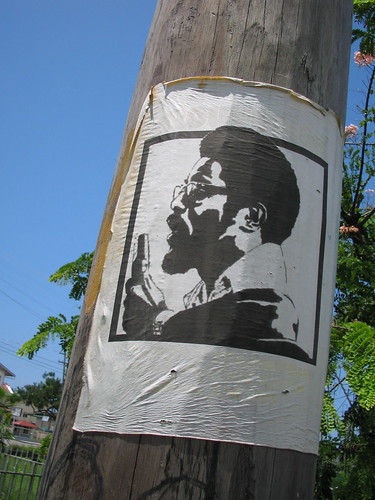
Poster from the commemoration of the 25th anniversary of Walter Rodney's assassination; Georgetown, Guyana, July 2005
(My favourite bit comes near the beginning, as Prabhala tries to recall what he learned about Guyana in geography lessons at school:
The only thing I thought I remembered for certain was that Brazil got its coffee from the Guyanas. It inspired hazy notions of dark, rich coffee in a dark, rich land.
As it happens, most coffee drinkers in Guyana are content with Nescafé, and Brazil mostly grows its own.
Naipaul wrote about the impossibility of getting a decent cup of coffee in Georgetown; it's one of many small brilliant turns in The Middle Passage. Visiting Guyana myself 45 years later, I discovered nothing had changed in that regard. I drank Nescafé--the chemically enhanced caffeine seems to go straight to your heart--every morning, and I'm not sure I've ever recovered.)
Caribbean lit links roundup
• At the Poetry Foundation blog, Harriet, Kwame Dawes recalls how he learned to love reciting poems out loud, and the importance of performance:
I am trying to replicate the spirit of those memories of how I first encountered the spoken word every time I face an audience.
• At Global Voices, Jonathan Ali summarises blog coverage of V.S. Naipaul's recent visit to Trinidad:
Those who did blog had mixed feelings about the visit, and in particular, the actions of Naipaul’s wife, Lady Nadira Naipaul.
• mediabistro.com's GalleyCat blog announces the names of some of the authors who will appear at this year's Brooklyn Book Festival in September, including Colin Channer and Staceyann Chin (both Jamaica-born).
• In a post called "5 Ways to Become a Major Poet or Problogger", Geoffrey Philp argues that the roads to success as a poet and as a blogger follow parallel routes.
• And, inspired by my "Bedside books" post of the day before yesterday, Imani of The Books of My Numberless Dreams says some very nice things about Antilles, and posts her own list of "Books by my (bed)side", from Homer to Hamlet to David Sedaris:
I often literally sleep with books or journals. Sometimes it is too much effort to turn over and place them on top of precarious table piles so I simply push them aside and fall asleep.
Subscribe to:
Posts (Atom)



 Posts
Posts


