
Links, links, links
- Geoffrey Philp explains "The Top Ten Things Every Writer Should Know". I'm particularly keen on number 6: "Read!"
- Ian McDonald muses (in last Sunday's Stabroek News over "losing the art of waiting awhile":
Consider the joy of writing and receiving letters. Delay is an essential ingredient in the pleasure of correspondence. "Must do" turns into the relished achievement of "just done" and then you have the added pleasure of anticipating a reply. "The sending of a letter constitutes a magical grasp upon the future," Iris Murdoch wrote. But that old magic has been completely destroyed by the fax and the e-mail.
- A.A. Fenty reflects (in today's Stabroek) on the news that Carifesta 2008 is going to Guyana.
- And Nalo Hopkinson offers a recipe for a writerly (and delicious-sounding) dinner. It begins: "In a big salad bowl, put mache (lamb's lettuce), chunks of zaboca pear, chunks of fresh ruby red grapefruit (any colour grapefruit will do. This just looks pleasing with the greens), parsley, some fresh grated ginger, and slivered almonds...."
Thursday, 2 August 2007

Tuesday, 31 July 2007
As it was in the beginning
Tomorrow is Emancipation Day here in Trinidad and Tobago (and elsewhere in the Caribbean), as well the official publication date of the August 2007 CRB. But it's also the anniversary of the launch of the original Caribbean Review of Books, first published sixteen years ago from the Mona campus of the University of the West Indies, edited by Samuel B. Bandara, assisted by production editor Annie Paul.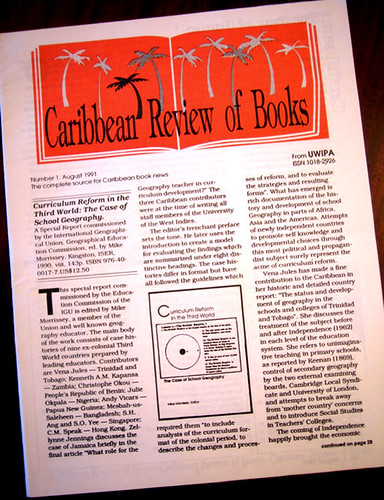
The August 1991 issue of the original Caribbean Review of Books
While I was in Jamaica last week, Annie--my delightful host in Kingston, and a regular contributor to the CRB in its current manifestation--managed to find me copies of the first three issues of that predecessor CRB, now carefully lodged on a bookshelf next to my desk. (I hope I can eventually assemble a complete set.)
The very first CRB opened with a review of an International Geographical Union report titled Curriculum Reform in the Third World: The Case of School Geography. It also included an excerpt from a lecture by Kenneth Ramchand, "West Indian Literature in the Nineties: Blowing Up the Canon"; an article on a co-publishing programme for children's books; and an essay by Sam Bandara himself, "Towards a Quantitative Analysis of Caribbean Books". And of course there are more reviews: for example, of From Plots to Plantations: Land Transactions in Jamaica 1866-1900, by Veront M. Satchell; of A Clinical and Pathological Atlas: The Records of a Surgeon in St Vincent, the West Indies, by A. Cecil Cyrus; and of Radicalism and Social Change in Jamaica 1960-1972, by Obika Gray. Plus four pages of brief "notices" of other new books, and a roundup of Caribbean journals.
The CRB as revived in 2004 focuses more on fiction, poetry, biography, and culture, with academic books (i.e. those intended primarily for a scholarly audience) getting proportionately less space. But what most strikes me are the similarities between the CRB then and now: the modest, spare design, fitting as much information and as many words as possible on each page; the straightforward enthusiasm for books and curiosity about the diversity of literary production in the Caribbean; the absence of jargon; and the high-minded concept of a magazine trying to bring together "Caribbean book people", as Mr Bandara described them (or us).
As I wrote a few weeks ago, I often find myself these days reflecting on the short lifespan of that original CRB (just about three years), and wondering if the present CRB will prove more successful at surviving the vicissitudes of the Caribbean publishing business. Holding that very first issue of the CRB in my hands somehow strengthens my resolve to make sure Mr Bandara's dream doesn't die a second time.
Sunday, 29 July 2007
All Men Come to the Hills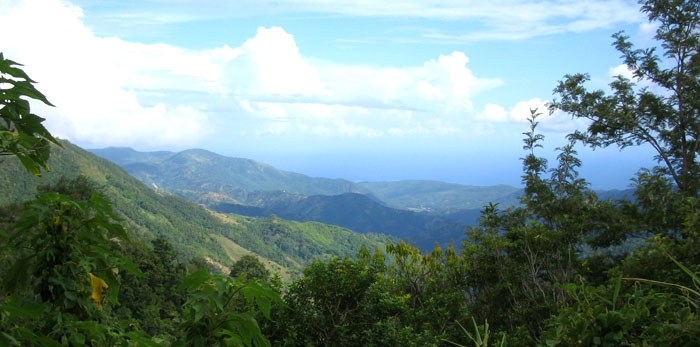
View towards the south coast of Jamaica from near Whitfield Hall
I'm just back a few days ago, dear readers, from a week in Jamaica, where I was again the guest of my friend and colleague Annie Paul in Mona. It was a busy and sociable week--I spent time with various writer friends, did some book shopping, and visited Rock Tower, the ambitious arts centre that Australian artist Melinda Brown is creating in a semi-abandoned brewery building in downtown Kingston. But the high point of the trip, in more ways than one, was last weekend, when I went hiking in the Blue Mountains with my friend Brian (one of my companions on my Venezuela trek earlier this year). We camped for a night at Whitfield Lodge, high on a ridge with a distant view of the sea, and on Sunday morning set out at first light on the trail to the summit of Blue Mountain Peak, the highest point on the island.
I've always been awed by the Blue Mountains, ever since I drove up to Hardwar Gap on my first visit to Jamaica some years ago, and I've always wished I had the wherewithal to stay a good long spell somewhere up there in the cool and the mist, surrounded by soaring peaks and plunging valleys. Mountains fascinate and comfort me--I grew up at the foot of Trinidad's Northern Range, after all--and I suppose what I love most about the Blue Mountains is the sense of serenity and refuge they make me feel. Sitting on the grassy terrace at Whitfield Hall, with the old coffee farmhouse behind and eucalyptus trees scenting the air above, I remembered Roger Mais's most famous poem, "All Men Come to the Hills":
All men come to the hills
Finally....
Men from the deeps of the plains of the sea--
Where a wind-in-the-sail is hope,
That long desire, and long weariness fulfils--
Come again to the hills.
And men with dusty, broken feet
Proud men, lone men like me,
Seeking again the soul's deeps--
Or a shallow grave
Far from the tumult of the wave--
Where a bird's note motions the silence in....
The white kiss of silence that the spirit stills
Still as a cloud of windless sail horizon-hung
•••above the blue glass of the sea--
Come again to the hills....
Come ever, finally.
Monday, 16 July 2007
Coming up in the August CRB....
Dear readers, you may have noticed that in the last few weeks posting here at Antilles has been rather light. It's not that we've run out of steam, and not that there hasn't been lots going on in the Caribbean literary scene. Rather, your Antilles blogger, who moonlights as CRB editor, has been hard at work on the August issue of the magazine, which goes to press later this week--and print deadlines ever trump all others.
So what might CRB readers have to look forward to in the August issue (our biggest yet)? Reviews of Leonardo Padura's Havana Quartet novels, of Bahamian art historian Krista Thompson's new book An Eye for the Tropics, of a new anthology of African diaspora poems, of Kwame Dawes's first novel, and of (former St Vincent and the Grenadines prime minister) James Mitchell's memoir. Short reviews of new books about the Taíno of Jamaica and Hispaniola, of poems by a writer from St Martin, of a memoir of Montserrat in the time of the volcano. An essay by David Dabydeen on the long-forgotten poems of the 19th-century Guianese poet Egbert "Leo" Martin. Marlon James on Jean Rhys's women. Garnette Cadogan on why we should pay more attention to V.S. Naipaul's non-fiction. Judy Raymond on the Trinidadian designer Meiling and "the business of selling dreams". A whole portfolio of Georgia Popplewell's photos from Calabash 2007. An interview with Geoffrey Philp. Poems by Vahni Capildeo and Thomas Reiter.
To make sure you don't miss all the above and more, renew your subscription, take out a new one, or give one to a friend!
Sunday, 15 July 2007
"No contradiction between the sensual and the spiritual"
I have always found comfort in the opportunity and permission to be devotional about sensuality and about the wonders of erotic love. The Song of Songs serve as a wonderful purpose in that regard. As a poem of sensuality it is exemplary and instructive. As a poem rooted in the use of metaphor it is a study in how to and how not to do it. As an example of a beautifully shaped narrative poem that employs refrain and counter point to create a dynamic of drama and aural beauty, it is a splendid example. But I have to return to the most critical value for me--that I like it for the permission it gives me to embrace the sensual. How the reggae artists got to that place of seeing no inherent contradiction between the sensual and the spiritual can be traced to many things, not the least of which would be the multiple cultural sources that fed Rastafarianism-—from African to India. However, what I do know is that in many of the great reggae songs, this quality is present. It is a similar spirit that I see in the Song of Songs and it is this quality that I am grateful for each time I read it.
--Kwame Dawes on the biblical Song of Songs.
Friday, 13 July 2007
What to read during Caribana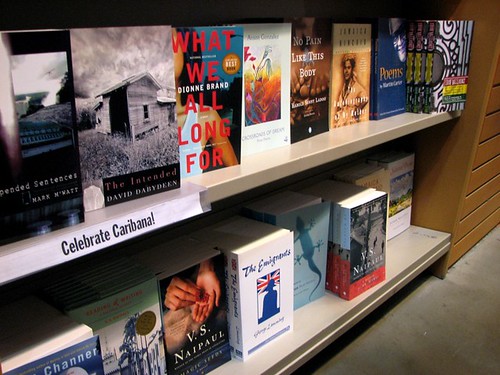
Georgia Popplewell is in Toronto for the second annual Caribbean Tales Film Festival. In a branch of the bookshop chain Indigo, she spotted this Caribana-themed display of Caribbean books--Naipaul, Carter, Lamming, Harold Sonny Ladoo, Jamaica Kincaid, David Dabydeen....
2006 Guyana Prize shortlists
The shortlists for the 2006 Guyana Prizes for Literature have been announced, according to an article in the Stabroek News.
On the shortlist for the best fiction prize: Cyril Dabydeen's Drums of My Flesh; Mark McWatt's Suspended Sentences (which won a Commonwealth Writers' Prize last year; the Guyana Prizes are biennial); and Ryhaan Shah's A Silent Life.
On the best book of poetry shortlist: Cyril Dabydeen again, for Imaginary Origins; Elly Niland's Cornerstones, and Berkley Semple's The Solo Flyer.
The best drama shortlist: Ronan Blaze's For Love of Aidana Soraya and Michael Gilkes's Last of the Redmen.
The winners will be announced at a ceremony on 23 August in Georgetown. This is the twentieth anniversary of the Guyana Prizes--still the only national book prizes in the Anglophone Caribbean.
Wednesday, 11 July 2007
Links, links, links
- Who invented rock and roll, asks Marlon James--why couldn't it have been Jackie Brenston?
- Geoffrey Philp reviews Crystal Rain, the new speculative fiction novel by Tobias Buckell, set in a futuristic world borrowing many details from the Caribbean.
- Imani wonders why better-made editions of classic Jamaican writers like Roger Mais aren't in print:
The Jonathan Cape omnibus of the novels was a hardcover and probably did not have any typos (though I suspect I’ve just forgotten them) but the pros stop there. It’s clear that that the publisher simply got three separate copies of the three novels, each with completely different fonts (not even the same size!) and stuck them together. *lifts hands into the air*
- Andre Bagoo is offering weekly "bedside books" updates:
Derek Walcott’s The Prodigal climbs to the top of my ‘active zone’, taking pride of place alongside his Collected Poems. The wonderfully produced American hard-cover edition of Zadie Smith’s bulky White Teeth caused some difficulty with the delicate balance that I have going....
- Kwame Dawes on reading Gerard Manley Hopkins's poem "The Windhover" as a young man:
For a poet living in a world in which language was constantly subjected to mutation, stretching, punning, and weighted with political and ideological meaning--and here I am speaking of the world being influenced and shaped by Rastafarians who forced us to take every word seriously, to test it for its possible implications and to see language as hardly locked in by tradition, but open to transformation, Hopkins’ poetry resonated for me--gave me permission, then to think of language, the Jamaican language I was learning, in different ways.



 Posts
Posts


