Embah: La Vie
Detail of La Vie (2006, 29 x 50 inches, mixed media on wood panel), by the Trinidadian artist Embah, whose work is currently showing (until 14 July) at the White Columns gallery in New York.
Thursday, 7 June 2007

"I will tell you..."
“I will tell you,” I said firmly. “They do not have baby.”
(No direct connection with Caribbean literature, but I couldn't resist.)
Wednesday, 6 June 2007
"They had simply gone elsewhere"
Marie Micheline went to live with my uncle Joseph and aunt Denise for the same reason that my brother and I did: our parents had disappeared. They had not abandoned us. Nor had they been imprisoned or killed by the henchmen of the dictatorship that had come to power in Haiti in 1957, when Marie Micheline was five years old and my parents had not yet met. They had simply, as my uncle explained first to her and then to us, gone elsewhere.
-- From "Marie Micheline" by Edwidge Danticat, an excerpt from her forthcoming memoir, published in the 11 June issue of the New Yorker.
Tuesday, 5 June 2007
Who's counting?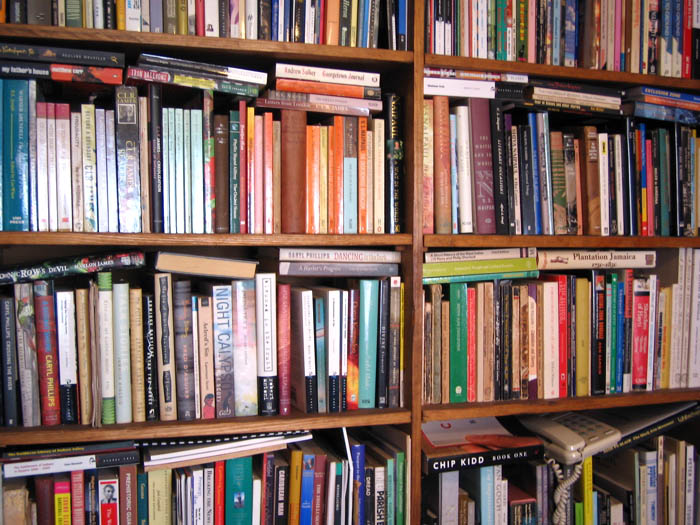
This throwaway comment by Fran Lebowitz--quoted over at Gawker, in a post about the 80th birthday party at the Strand, my favourite used book shop in New York--got me thinking:
Fran Lebowitz got off a good line about wishing the Strand was her apartment, and how New York is divided into two groups of people: "people with five thousand books and people with the space for them."
Five thousand doesn't seem an unreasonable number of books to have amassed by early middle age over the course of a readerly life, does it? By my rough estimate, the shelves in my small study can hold about two thousand books comfortably, so if I factor in the overflows onto floor, desk, and other items of furniture, there might be almost 2,500 books close to hand as I sit here typing.
There is another bookcase in the corridor outside--well, two, but one is full of magazines--and another in my bedroom. Somewhere in the house are about a dozen boxes of books in a more secluded form of storage--they include my shockingly large collection of ratty paperback detective novels, which I read avidly as a teenager. I recently discovered a stash of books in the freezer--double-Ziploc'd--where I'd put them months before in an attempt to end a powder-post beetle infestation. I don't think I'd have the energy to do a proper book census even if I wanted to, but a safe guess would be that I own about 3,500 books, in varying stages of moulder, decay, and consumption by insects.
Have I read them all? Hardly. I own hundreds of books, probably, that I'll never get around to reading, but it's nice to have them handy just in case. I also own many duplicate copies--two full sets of Jane Austen, for instance, just by chance. And many reference books or scholarly volumes I might dip into once or twice, in search of some abstruse fact, but which I'll never read cover to cover. And many many books I've already read, will probably never read again, but which I have no intention of discarding. I've never understood people who give away books once they're "done" with them. Are you ever really "done" with a book? If there's even the smallest chance you may re-read it someday? And isn't it in some sense comforting--physically comforting--to have books around?
And why--surrounded by books, as I clearly am--indeed, tripping over books, as I occasionally do--does it so often seem I have nothing to read?
Danticat on Díaz
"It's one of those stories that you like in spite of yourself. You think ... I shouldn't really enjoy this character, but you do." --Edwidge Danticat, discussing Junot Díaz's short story "How to Date a Brown Girl (Black Girl, White Girl, or Halfie)" with New Yorker fiction editor Deborah Treisman, in this month's New Yorker Out Loud podcast.
Monday, 4 June 2007
Last taste of Calabash
Is it really a whole week, dear readers, since I returned from Jamaica and the Calabash International Literary Festival? Here's a final roundup of Calabash 2007 coverage:
- Kwame Dawes, one of the three Calabash principals (with Colin Channer and Justine Henzell), has written a detailed account of this year's festival in a series of posts over at Harriet, the Poetry Foundation blog: arrival, day one, day two, and day three.
- At the UK Guardian books blog, Toby Lichtig writes about experiencing what he calls "a literary festival with a different flavour" (that flavour was rum punch and conch stew, from the sound of it).
- The Jamaican newspapers have understandably been full of Calabash coverage over the last week. Today in the Observer Tyrone S. Reid interviews Justine Henzell, and is bowled over by her charm.
- And the young Jamaican photographer Varun Baker has posted his Calabash photos at Flickr, joining the excellent selection already posted by Georgia Popplewell.
If I've missed any interesting Calabash coverage, either in blogs or in the mainstream media, I'd love to know. Please leave links in the comments below.
More bedside books
I know, dear readers, Friday is supposed to be "bedside books" day. But last Friday I was busy preparing for the "Finding the Thread" event and didn't manage to post anything to Antilles at all. Let me try to make good. Georgia Popplewell of Caribbean Free Radio hasn't written for the CRB in ages, but perhaps her contributing this list--of books she's taken on her nearly-three-week sojourn in Tobago--is a sign that she'll soon reappear in our pages.
Having returned from another trip only the day before, I had only a few hours to pack for my move over to Tobago, so among the many rapid decisions I was forced to make was selecting the 18 days' worth of reading matter I'd be taking along. On account of the volume of reading I do daily on the web, my rapidly worsening ADD, and my aversion to clutter, I've begun to limit myself to reading one book at a time (which I'm aware marks me as a weak-minded philistine), so when I'm at home it's unlikely that you'll find more than one tome at either my actual or metaphorical bedside at any given time. In a borrowed bedroom, however, you sometimes don't have a choice. Here are the books that made it over to Tobago in a box on the back seat of my car, and which now sit on my bedside table:
- Ruchir Joshi's The Last Jet Engine Laugh, which I'm in the middle of right now. One of the two or three best meals I had during my visit to Delhi last December was taken in the company of Ruchir, who also introduced us to the joys of masala peanuts, so I was curious to see what sort of novel this slightly mad, generous-spirited human would produce. So far it's a highly entertaining read, beautifully written, occasionally baffling. Set partly in the year 2030, one of its sub-plots speculates on the fate of Indian independence leader Subhash Chandra Bose, who may or may not have died in a plane crash over Taiwan in 1945.
- Irène Némirovsky's Suite Française. I'm yet to read a bad review, and I'm also fascinated by the circumstances of its creation.
- Modern Baptists by James Wilcox. I first read about this book, which was first published in 1983, in a 1994 New Yorker article which hailed it as a work of comic genius. 13 years later, I've finally got myself a copy.
- Everything is Miscellaneous by David Weinberger. Weinberger is on the Global Voices board of advisors, so he's sort of a colleague, but I'm also deeply interested in the ideas the book explores, which have to do with how shifting to the digital space changes how people think, organise and categorise. I'm also behind on my reading of the key texts on new media (which, after all, is the field in which I currently make a good part my living) so Miscelleanous is partly meant to kick me (backwards, it's true) in that direction. Ethan Zuckerman described the experience of reading the book, by the way, as ". . . a little like drinking a mojito - smooth going down, but deceptively powerful, and slightly staggering when you get up to buy the next round." As it so happens, I love mojitos.
Plus several weeks' worth of New Yorkers and a couple of books on photography, the other pastime that keeps me from reading more, notably Bryan Peterson's Understanding Exposure.
Thankfully, the house where I'm staying has a decent selection of books in case I exhaust the supply I've brought (highly unlikely) or feel in the mood for something else, but there are two books I wish I'd put in that box in the back seat of my car:
- Maryse Condé's biography Tales from the Heart, which I picked up last week at the Calabash Literary Festival after hearing Condé's husband and translator, Richard Philcox, read an excerpt. The only Condé work I'd read previously was La vie scélérate, which didn't bowl me over, but the biography sounded interesting, and I've found myself wishing, lately, to re-connect with the French Caribbean.
- And A Matter of Taste: The Penguin Book of Indian Writing on Food, because you should never leave home for 18 days without a book of essays, and because it might inspire me to do some actual cooking while I'm here.
--GP
Sunday, 3 June 2007
Sunday links roundup
- The Arts and Leisure section of today's Jamaica Gleaner offers a review by Mary Hanna of Erna Brodber's new novel, The Rainmaker's Mistake, as well as two short stories: "Sailing from DaMarie Street", by Kimmisha Thomas, and "The Day That Thou Gavest", by Cordella Lewis.
- Also in the Gleaner, Anthea McGibbon reports on a show of Jamaican art, "dominated" by David Boxer and Milton George, at the Pan American Art Gallery in Miami; and Jonathan Greenland, director of the National Gallery of Jamaica, interviews artist Stafford Schliefer.
- In the Stabroek News, Al Creighton reviews Panorama: A Portrait of Guyana, the annual Independence show at the National Gallery of Guyana; and Ian McDonald asks, What is the relevance of poetry? Pure enjoyment.
- Who has Edwidge Danticat been reading lately? J.M. Coetzee and Nikki Giovanni, according to a feature in today's New York Times Book Review, in which various writers are asked about their recent reading choices.
- At the Poetry Foundation blog, Kwame Dawes writes about "copyright matters", in response to a question by Kenneth Goldsmith.
- Geoffrey Philp remembers Don Drummond with a podcast of Mervyn Morris's poem "Valley Prince".
- And Caribbean Free Radio posts the June tour schedule of Antiguan writer Marie-Elena John, who will be making appearances in and around Washington, DC, and New York in the coming weeks (read a recent interview with John, posted a couple of weeks ago on Antilles).
Subscribe to:
Posts (Atom)


 Posts


